
Numismatic 1954 quarter value activates upon reaching the MS 66 grade or higher.
| Parameter | Value |
| Mass | 6.25 grams |
| Pure Silver | 5.62 grams |
| Composition | 90% Silver, 10% Copper |
| Diameter | 24.30 millimeters |
| Designer | John Flanagan |
A mass deviation exceeding 0.194 grams indicates heavy circulation.
Emission Statistics
Total 1954 mintage reached 108,552,425 pieces.
Distribution by mint locations:
- Philadelphia without mint mark — 54,412,000 units
- Denver mark D — 42,305,700 units
- San Francisco mark S — 11,834,725 units
The San Francisco mintage represents the lowest volume in this yearly cycle.
Relative scarcity for the S-mint creates potential for price separation.
Philadelphia (1954 No Mint Mark)
Philadelphia coins appear most frequently in circulation and private holdings.
Their value in lower categories depends directly on precious metal quotes.
| Grade | Price in USD |
| AU 50 | $8.50 |
| MS 63 | $12.00 |
| MS 65 | $28.00 |
| MS 67 | $550.00 |
| MS 67+ | $1,250.00 |
The price jump between MS 65 and MS 67 equals 1864%.
A record sale occurred in 2020 at Heritage Auctions.
An individual specimen graded MS 68 sold for $4,320.00.
Liquidity Factors for the S-Mint
San Francisco mint issues often possess a characteristic soft luster.
Specialized die polishing on the West Coast causes this effect.
Price dependency scheme for 1954-S:
MS 64 → $18.00 MS 65 → $25.00 MS 66 → $45.00 MS 67 → $275.00 MS 68 → $7,500.00
The survival rate in MS 68 remains extremely low.
Only a few units have PCGS certification in this condition.
Percentage change in value over the last 5 years:
- Standard MS 65: +12%
- Top-tier MS 67: +40%
Proof Quality Coins: Exceptional Clarity
Philadelphia minted 233,300 Proof sets during 1954.
These coins served exclusively for collector purposes.
A mirror-like field remains a mandatory requirement for this category.
Price benchmarks for 1954 Proof:
- PR 65 — $35.00
- PR 67 — $75.00
- PR 68 — $180.00
- PR 69 — $1,100.00
Collectors prioritize coins showing contrast between the field and relief.
The Cameo designation adds between 50% and 150% to the base price.
Deep Cameo specimens occur rarely due to rapid die wear.
The record for a 1954 PR 69 Deep Cameo stands at $10,200.00.
Denver Issue: 1954-D Analysis
Coins bearing the D letter on the reverse below the wreath often show die clash marks.
This reduces the quantity of perfect samples on the market.
| Grade | Market Quote |
| MS 65 | $32.00 |
| MS 66 | $55.00 |
| MS 67 | $380.00 |
Demand dynamics for 1954-D remain stable throughout the decade.
The absence of sharp fluctuations makes this issue a conservative instrument.
Investors use such positions to hedge risks in volatile sectors.
Mint Errors and Rare Varieties
Technological failures in 1954 produced a limited number of defective coins.
Such units cost significantly more than standard samples.
Primary error types:
- Double Strike — the image sits off-center.
- Planchet Error — striking on a disk meant for a five-cent piece.
- Die Crack — a raised line appearing on the coin surface.
Double strike value with 50% offset starts from $450.00.
A coin struck on a different metal blank costs over $2,000.00.
Detecting these artifacts requires using Coin ID Scanner.
2026 Market Trends
The modern numismatic market has transitioned into a phase of digital transparency.
Investors rely on coin population reports.
Survival statistics for high-quality specimens: Philadelphia MS 67: 165 units → rare category Denver MS 67: 210 units → moderate availability San Francisco MS 67: 180 units → steady demand
Increased numbers of certified coins slow price growth in the middle segment.
A deficit in MS 68 grade provokes aggressive bidding at auctions.
Influence of Silver Metal on Final Valuation
Metal value provides capital insurance.
With silver priced at $30.00 per 31.1 grams, the metal value in the coin is about $5.42.
A 10% rise in metal price → an 8% lift in AU coin value.
Collectible specimens respond less to metal price fluctuations.
Historical significance and rarity serve as the primary drivers for these items.
The Grading Process: Evaluation Criteria
Professional certification determines the financial success of a transaction.
Experts evaluate a coin based on four parameters:
- Retention of mint luster.
- Quantity and depth of field scratches.
- Clarity of Washington’s hair and eagle feather details.
- Uniformity of the patina.
Evidence of cleaning voids all numismatic value.
A cleaned coin equals the value of silver scrap metal.
Comparison of 1950s Issues
1954 sits in the middle of the decade regarding value.
Mintage and MS 66 price comparison: 1952-S: 10 million units → $110.00 1954-S: 11.8 million units → $45.00 1955-D: 3.1 million units → $65.00
1954 offers an advantageous entry point for building a year set.
Low entry costs for MS 66 allow for high-level collection assembly.
Long-Term Ownership Planning
Holding 1954 coins for 10 years shows returns exceeding inflation.
The average annual increase for MS 67 reaches 6.5%.
Factors supporting growth:
- Physical loss of coins due to silver melting.
- Growing numbers of active market participants in Asia.
- Improved conservation methods.
Storing in special acid-free containers prevents surface degradation.
Auction Result Analysis
Studying completed trades provides a realistic demand picture.
Stack’s Bowers sale in 2024: Lot 1954-S MS 68 — result $8,100.00.
eBay sale in 2025: Lot 1954-D MS 67 — result $415.00.
Price variance confirms the importance of visual appeal for a specific coin.
Patina Color Characteristics
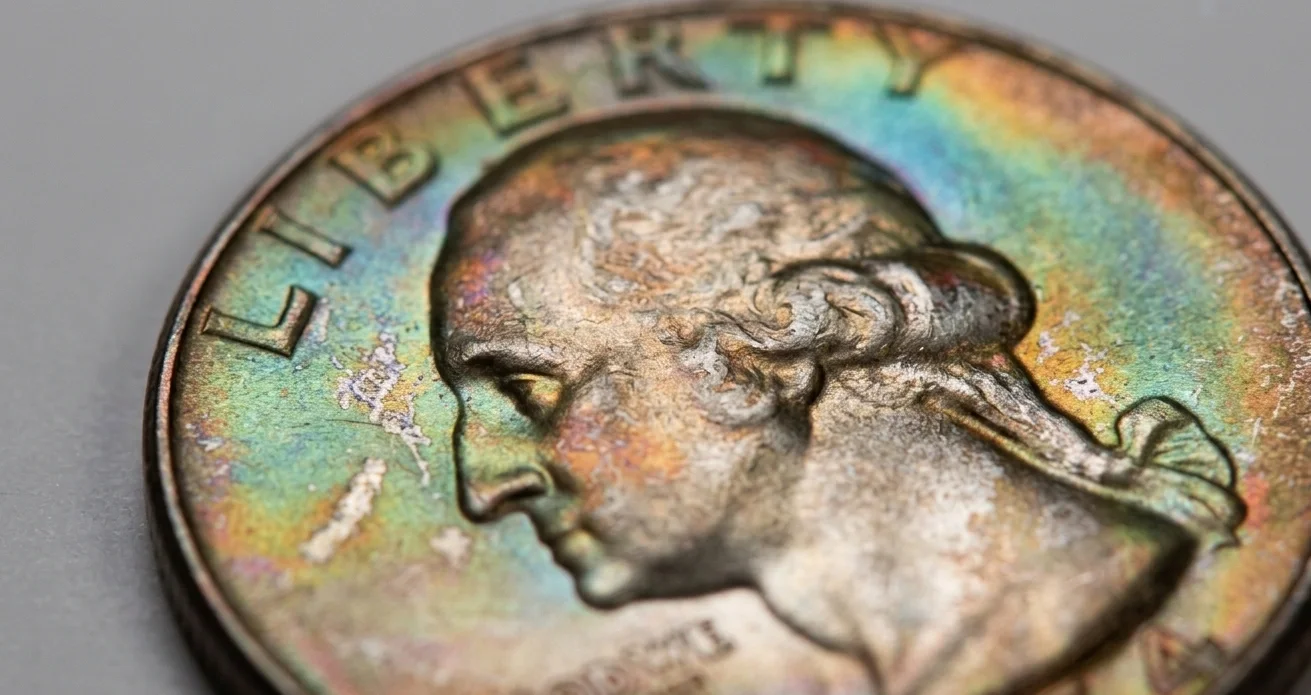
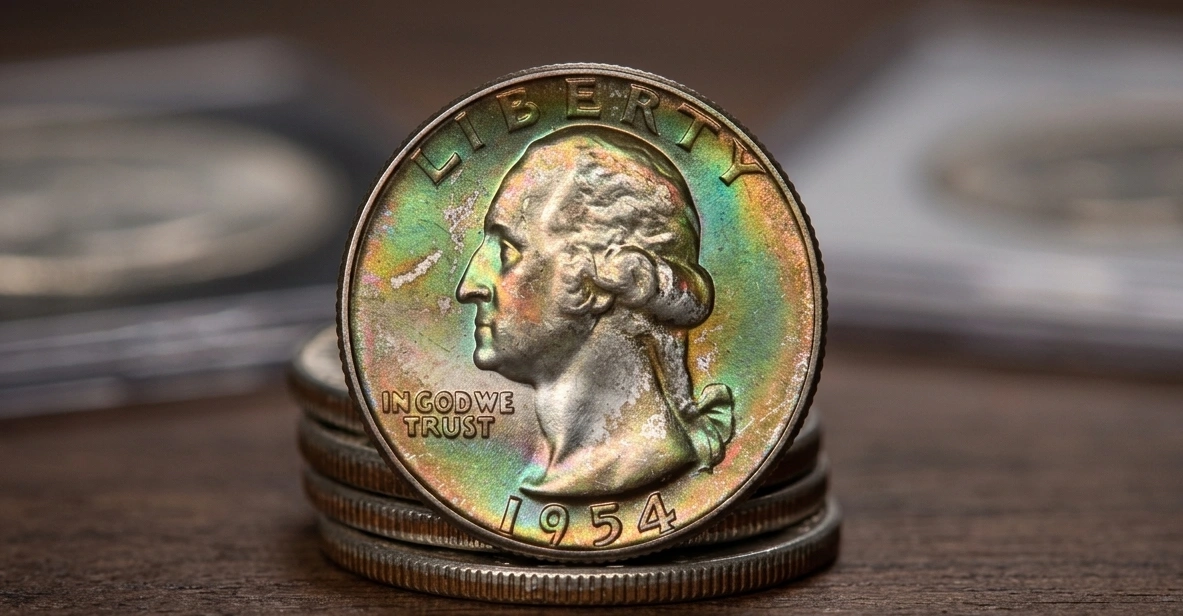
1954 silver coins tend to develop rainbow patina.
This effect occurs when storing in original Treasury paper envelopes.
Coins with bright Blue and Gold patina attract premium buyers.
Earning an aesthetic markup can reach 200% of the base catalog price.
Natural patina proves the coin never underwent chemical treatment.
Geography of Finds and Availability
The highest number of uncirculated coins survived in bank rolls.
One roll contains 40 coins.
Opening an original 1954 roll in 2026 remains a rare event.
Finding an MS 67 coin inside a roll happens in less than 5% of cases.
Most units suffer damage from rubbing against each other.
Authentication of Genuineness
High-quality fakes from China exist on the market.
Using spectral analysis helps identify alloy inconsistencies.
A real 1954 quarter must produce a clear, ringing sound when dropped.
However, professionals avoid sound tests to prevent damage.
Visual inspection with the coin app reveals characteristic strike lines.
Final Asset Evaluation
The 1954 quarter represents a balanced asset.
Combining high silver content and numismatic perspective creates leverage.
Choosing coins in slabs with clear marking remains critical for investors.
Philadelphia provides volume while San Francisco offers growth potential.
Denver serves as a middle link for diversification.
The 2026 market confirms the viability of this investment model.
Careful specimen selection guarantees the safety of invested funds.
Numismatics remains one of the few markets having tangible backing.
Purchasing Recommendations
Periods of quiet in commodity markets offer optimal buying times.
A silver price drop to $22.00 creates a window of opportunity.
Avoiding auctions with blurry photographs is necessary.
High-resolution scan requirements are the 2026 standard.
Comparing lots against auction archive databases helps avoid overpayment.
Correct condition assessment ensures future profit when exiting the asset.
Mint branch diversity allows for flexible budget management.
A 1954 investment pays off with a planning horizon of 3 to 7 years.